Ive learned a lot over the various projects this semester. Coming into this I really only had experience with written storytelling so it was nice to get to branch out and learn new skills. Over the course of this class I learned to lean into multimedia storytelling more and more which I was timid with at the beginning but by the end I felt confident in using audio, visual, and video elements to convey my message.
I really like the game Deadlock (if that wasn’t clear by this being my second project inspired by it) so it was awesome to get to write some fan fiction about an event which is not really discussed much in the lore other than in passing. I really love all of the Deadlock characters, but Lash is definitely one of my favorites so of course I chose to write about him. One of the elements that is explored in the lore but I wanted to write more about was the dynamic between Lash and Vyper. It does get brought up in the lore a fair amount, and Vyper references being there when Lash lost to Bebop so I wanted to imagine how that happened. I really wish I could have incorporated more video elements into this project but sadly by desktop which has all of my video editing software on it is out of commission right now so I had to make do. It was fun to take a foray into animation even if it was just a gif. I think I could have done a better job but this was my first time animating something in Procreate. At first I tried to look to the assignment bank for inspiration but the only thing that really inspired me was the “make and animatic” assignment. I deviated from it a bit by making a gif instead of an animatic though. Ultimately I decided to just write and then see where other elements would fit and I think that worked out alright. Overall I think I did a good job weaving multiple mediums to create a story in this project but I definitely could have featured more video elements.
If I had a Time Machine
There isn’t much I would really have liked to change about how I approached this class. I think if I had a time machine I would probably go back to warn my past self about my cat knocking over my desktop if anything. My favorite part of this class was having a push to make me write more. I love to write but it’s very easy to get sidetracked or never even start so having deadlines to meet really helped me get out there and make something. My favorite project was definitely the final getting to put everything I learned throughout this class to use.
I Liked getting to read some treatises on filming as I find the art behind it quite interesting. Most of my family are big movie buffs so it’s something that has been a part of my life for a while. I will say I find writing about film more interesting than reading about it however so I was excited to get to the next blog and could have done more with this one.
This was my favorite part of the assignment be far. I really love doing critical analysis of pieces of media I enjoy so this was a treat. Aoi Todo is one of my favorite characters and I think his reintroduction to the narrative really suits him. I hope I provided adequate reasoning as to why I think the scene is good.
Deadlock is one of my favorite games so getting to make a video out of my gameplay was fun. Trying to get the text to scroll on screen at the pace I wanted it to drove me up the wall though. My video editor really wanted it to go slow and I had to mess around with Python to get it to work.
I really like to make composited meme videos like this. My family does not like them and thinks they are overstimulating but I don’t let that stop me. It can be very hard to come up with good scenes to mash together. The vine boom sound effect on a TikTok gave me the idea for this one.
The character for this one is me. I work for the company community IT Innovators. It is a really good job, or technically paid internship. It suits my field of study in communication well and has been a great opportunity to develop workplace skills. I have been working there for about a year now. Most of that time I was working less than ten hour a month however this summer I was given the opportunity to have a more intensive summer internship which I gladly took.
My Workplace
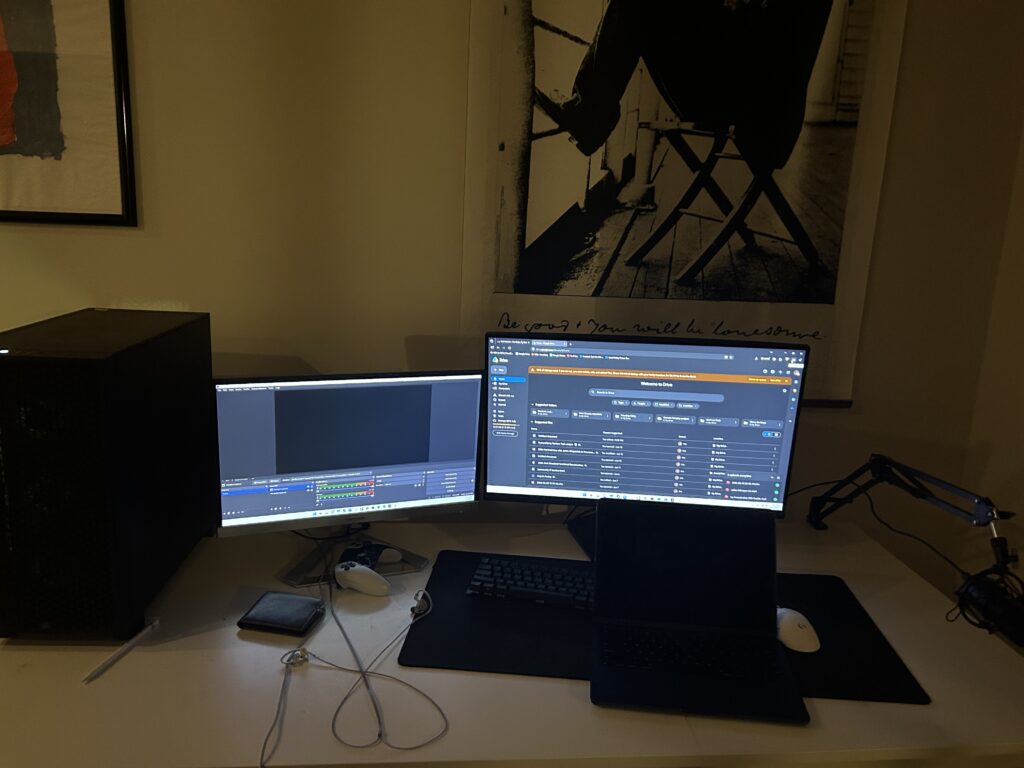
My position is fully online remote so I get to work from wherever I am. Usually this means either at my desk or dining room table. I prefer my desk as it’s more comfortable to work there. I have a good setup for both working and gaming the only thing that bothers me is that it is right underneath my families living room so if they are watching TV up there it can be distracting.
Reflection
I have learned I lot working for Community IT and I am very grateful to have been given my position. It’s the best job I have ever worked by far. All of my bosses and coworkers are kind and I make twice the hourly wage I made at Dominoes (although I only work half the hours). My hope is that I could get I job like this one when I graduate with my comms degree because its about as perfect as job as you could ask for in 2026.
To give the context for this scene, our main character Yuji (pink hair blue clothes) is at his breaking point. He has lost both his mentor and one of his best friends to the curse Mahito (grey hair, scars on face) within the span of a few minutes. He is about to give up and suffer the same fate before someone steps in to tell him what he needs to hear. He is saved by his friend Aoi Todo who has the power to switch things places by clapping his hands. Todo has been absent from the narrative since the later half of the first season now over two dozen episodes ago. This scene takes place at the very begging of episode 44 of Jujutsu Kaisen, and since its release in December of 2023 it has become one of the series most iconic moments. It is also incorporated into the 2025 movie adaptation of the latter half of the second season Jujutsu Kaisen: Execution
The scene starts with our protagonist and antagonist in the lower left hand corner of the frame out of focus. This distances us from our characters and makes our cornered protagonist Yuji feel even more isolated. We then cut to Mahito’s leering face and then to his arm transforming into a blade with which he slashes at Yuji. The slash is from the direction of right to left and aligns with the negative connotations of that axis of motion. The camera then once again cuts to a distanced shot from Mahito and a now missing Yuji. This shot makes Mahito appear small and creates confusion by begging the question “Where did Yuji go?”. The camera then cuts to a close up of an unknown character focused on his chest and hands clasped in prayer in the lower left corner of the frame. In the upper left we see a silver locket on a necklace sparkling to catch our attention. The camera then cuts to a shot of the mans feet, the panning up to once again bring the mans chest and hands into center frame before traversing further upwards to focus on his neck and once again the locket. This sequence puts a great deal of emphasis on the main and his necklace with our revealing his identity. Through the pan up from his feet this shot makes him feel large and intimating especially given the pause on his muscled arms. This is contrasted by his hands in the first shot being in a position of prayer which implies that this man is more than just the cavalry arriving as it were. We then once again cut to his feet further reinforcing his size and stature with clouds of dust rising from his every step. We are then taken to a more distant shot of Yuji’s would be rescuer out of focus and Mahito focused and in frame on the lower right. We also see Yuji collapsed on the ground next to our mystery rescuer bringing us back to the Chekhov’s gun of this scene and revealing what happened to Yuji. There is then a brief cut to our new character loosening his jacket before we cut to a closeup of Mahito’s now scowling face. The fast action of the jacket being loosened is disruptive to the otherwise slow and deliberate movements of this character implying he is preparing to make his move. Mahito’s face says everything we need to know about how he is feeling without words. We then cut to a closeup shot of our mystery characters head and shoulders revealing his identity to be Yuji’s close friend Aoi Todo. While the focus of this shot is on his head and identity at the bottom of the frame his is still adjusting his jacket showing he is reading himself for a fight. His face and background are well lit shining a proverbial spotlight on his big reveal. This shot is also looking up at him affirming his status as a strong rescuer rather than just another lamb to the slaughter.
The scene starts with ambient audio befitting a large space and the androgynous tones of Mahito questioning Yuji on if he can recall the number of curses he has exorcised. He does not give Yuji time to answer but instead excitedly blurts out that he cannot recall how many humans he has killed and that it does not matter. There is then a sliding metallic sound followed by the sound of something moving swiftly through the air. The sound design on these is really good and lends a sense of realism. There is then a single well isolated clap that reverberates slightly. This clap is clearly meant to be focused on as there is then silence filled only with its echos. A low masculine voice breaks the silence saying “The sound of the Gion Shoja bells…” which is then interrupted by the introduction of a rising score and choir. The voice then goes on to say accompanied by triumphant music “… the color of the Sala flowers, echoes of the impermanence of all things, revealing the truth that the prosperous must decline.” then as the music reaches its apex “But, we are the exceptions.” the music then fades to the music of the opening credits. The lines of Aoi Todo speaks in this scene are in reference to the Classical Japanese epic the Heike Monogatari. The passage of the epic Todo references is about the fall of one ruling political family and the ascension of another. However while Todo faithfully conveys the first half of the passage he adds his own ending in defiance of the passages original moral. Here Todo injects his own philosophy much as he has injected himself into his current position to save his friend. Mahito’s power and motivation is one of constant change and transformation, and Todo has in his reintroduction to the narrative not only denied Mahito’s attempt on his friends life but also renounced the ideology of his opponent. Previously on the cusp of victory Mahito is now challenged not only in the context of the fight which Todo has now entered but his ideology of change which has been nearly victorious mere seconds ago is also now challenged as Todo proclaims he and Yuji are the exception to the unstoppable flow of change that Mahito represents. The music accompanying Todo’s proclamation is not a rock and roll anthem of frenzied bloodlust to avenge fallen allies or an orchestral score to highlight greatness, instead it is a slow piece with a coir to reinforce the magnitude of a man willing to stand in defiance of the inevitable. This match of dialogue, music, and philosophy makes the sound of this scene great.
All Together Now
When taken as one whole I can see why many fans declare this scene to be the series best. The spectacle of the visuals draw attention to the words spoken by Todo in a way that puts their significance front and center. Even though some of the deeper meaning and references behind his monologue may be lost without some deeper digging it remains clear that Todo is here to make a splash and change the tides. I do not necessarily think that anything new is added by combing both sides but rather the best characteristics of both are enhanced when put to gather, making what was already great greater.
My main takeaway from both “How to Read a Movie” and “15 Essential Camera Shots, Angles, and Movements” was that cinematography is an extension of the techniques used for a still image. The first of the techniques discussed in “How to Read a Movie” was the rule of thirds, much as with still photography. On that topic I found the information about how figures to right of center are seen favorably and figures to the left are not. What I found even more interesting about this was that this perception appears to not be affected by the reading direction of a persons native language. I find this fascinating because many similar phenomena such as which way people look when crossing the street are affected by language.
Secondly I would like to brig attention to the tilt shot as discussed in “How to Read a Movie”. This is one of my favorites as it has been used in some of my favorite scenes in television and movies. I really appreciate it being mentioned as the impact it can bring in conveying a characters state of mind is immense. I think that this effect is often under appreciated in favor of more flashy effects but it is still defiantly my favorite.
Lastly I would like to talk about high vs low shots. Much like how left vs right can affect perceptions of characters high shots and low shots can have a similar effect. High shots make the subject seem small, unimportant, or weak. Meanwhile high low shots make the subject appear larger, stronger, and potentially intimidating. These effects can be combined with the target being left or right of center to guide the audience to form opinions of a character. n
I found Glass’ take on the perseverance required to find a good story to be interesting. I think commonly people think that anyone with right skills can make anything interesting so to say that even the best cannot make a bad story good was novel. I also liked the emphasis on being picky right from the start to make only the best work. I think the tone of the interview was intriguing as it was quite terse yet also encouraging, it reminded me a bit of my grandfather.
I listened to Spook’s Night at the Aquarium. this piece made extensive use of music to set the tone and build atmosphere. It also used a wide variety of sound effects such as radio static and creaking doors to really sell the audience on its location. Lastly the episode made excellent use of pacing to keep the reader hanging on every word.
I learned a lot about how to utilize all of the sounds in a story to tell it, even the lack of sound. I think this helped me focus on the little things rather than just a main speaker as I may have done before. I also got to try my hand at music which was fun.
I had a hard time learning to use new software tools to make things sound the way I wanted. I am experienced in audacity but I took my first forays into installing plugins and using garage band in this assignment which made for a good challenge.
I had an easier time writing this week as I had time off work that allowed me to dedicate more of my creative energy towards these projects.
I had in issue with my mic picking up a nonexistent buzzing noise that was driving me up the wall. I tried several methods to filter it out but to no avail.
I most enjoyed getting to try and make music. I was something I had been wanting to do for a long time and this was the perfect thing to get me to finally take the plunge.
Listening to the intro of Spooks Night at the Aquarium– Classic one thing stood out: The music. Fading in and out the masterful scores contribute to building anticipation but also anxiety. Keeping you expecting a grand reveal for the entire duration of the intro until finally you are hit with the episode title and the pressure temporarily abates. I think this is excellent audio design not only because it stirs the interest of the audience but also because it mirrors the subject matter of the episode. The in and out of the music mimics the rising swells of a wave and then the momentary trough before the next crest surges forward. Thus it not only catches the listeners attention hook line and sinker but also lures them into the briny depths in which the episode takes place.
Summary
The episode follows night guard Kevin Wright as he shares his experiences working at the supposedly haunted Monterey Bay Aquarium. He starts off telling us the history of the location. He then explains some of the legends surrounding the aquarium told to him by other guards. The rest of the episode is then dedicated to him recounting his own encounters with the unnatural.
Sirens Voice
To say Glynn Washington’s voice is anything less than spectacular would be deception of the highest magnitude. But what I think does not get enough credit is his cadence. He paces himself so as to be as fast as the listeners mind is racing and then slow down when he needs to draw out their curiosity. The introductory anecdote is a perfect example of this. he builds up a mix of swirling mix of interest and anxiety before slamming the breaks to deliver his chilling conclusion. His pacing is wonderful, and though it may not take center stage it is a driving factor that puts the wind in his shows sails.
the use of sound effects in this episode is excellent. The ambient bubbling and splashing of water brings the story to life in a way that may fly under the radar. Instead of being intrusive these sounds truly do blend into the background of the speakers voices, as though you were with them in the aquarium itself. I find that often ambient effects like these can become annoying and detract from the story being told or they are not noticeable enough to even impact your perception of the tale. I think Spook has struck a carful balance here that nets the listeners mind and drags it into the kelp forests of the Monterey Bay Aquarium.
The sound of footsteps and jingling keys build ambiance in a way the takes the experience to the next level. In a manner reminiscent of watching a movie with your eyes closed Spooked builds a mental image of the happenings in their eerie episodes. Much like with ambient effects they make sure not to over do it but instead have just enough to paint their picture without overshadowing the speaker. The ringing of ships bells and radio static when our storyteller recollects speaking over his walkie talkie immerse you in the memories recounted to us as if you were there yourself.
The End
Night at the Aquarium draws the listener in and never lets them go. Through the techniques outlined above the creators ensure that you are hanging on their every word and your heart is racing to reveals of something as mundane as an octopus. They create an image so vivid in your mind that you can see the sardines circling above you, flashes of silver moving like stars in the dark night. Although some of the mysteries are solved the episode leaves you wondering what really happened. Check it out here
One of the things about the Ira Glass interviews that stood out to me most was the emphasis on being picky and the true rarity of good stories. I think this is a theme that can be observed throughout the informational segments of the previous modules as well, being an explicit tip in the photography module and a more implicit theme in the Vagnelli Canon. I think this pattern is indicative of the importance of being picky when making art. If you are not willing to go as far as possible to identify the best base what you build upon it will be degraded by its quality. Much as the leaning tower of Pisa leans because of its less than stable foundation a work based on a less than ideal starting point will suffer its bases flaws.
The second takeaway from the interviews I had was the importance of not talking about yourself. This is a tip that is commonly given on how to be a better conversationalist so it is fitting that it would apply to the interview format. I think that the section about this serves not only to facilitate better interviews but also teach you better interpersonal communication skills which are of course essential to being an entertainer.
The third takeaway I had was the emphasis on endurance. I really liked what Ira said about having to just keep pushing until you make something great. I think it is very easy to get discouraged seeing so many brilliant pieces of art out there and trying to measure yourself by their standard. I really liked what he said about how you don’t see the many failures that were endured to create those gems. Despite the tone throughout many of the interviews being rather terse I think the underlying message was one of perseverance and encouragement.
I think I learned a lot about design in this unit. I particularly enjoyed reading the Vignelli Canon. I enjoy getting to learn from the greats and I really enjoyed getting to sit and mull over the concepts from the canon. The design blitz was interesting and I enjoyed it as an opportunity to use my critical analysis skills which is always fun. The diversity of choice when it came to picking what to analyze though was almost paralyzing for me. the design assignments were interesting but by far the part of this assignment I cared the least for. While I enjoy creative writing I just found the other sections far more appealing.
What did I learn?
I think I learned a lot about the importance of planning when it comes to design. I have ADHD and I tend to jump into things headfirst with no plan, so I think that learning more about how you can plan and pace yourself for a project was very helpful.
What was hard?
I had a lot of on the writing elements . I have had a long week at my job which involves a lot of writing so I was kind of burnt out and really had to dig deep. I think in a way this was helpful though because the type of writing used for these assignments was a nice change of pace from my work writing.
What was easy?
Making the designs for the design assignments was much easier than I expected. I am not very talented at working with visual design programs so I was pleased that my designs came out as well as they did.
What was frustrating?
The digital assignments website was incredibly slow for me. I would take several minutes to load each page and it got to the point where I would get up and leave my computer to do something else whenever I needed to load a new page. This really took me out of my workflow.
What was enjoyable?
As I alluded to in my intro I really liked reading the Vignelli Canon. I had not heard of it before so it was interesting to read and see how the concepts in it influenced so much of the word around me.
To open I would like to talk about how I really liked the idea of semantics covered in the vignelli Canon. I think that knowing what you are making before you make it is the key to well designed works. When viewing works I believe you can easily tell when something was designed with forethought because its elements will be there with a purpose rather than just to fill the page. I think that concept really shines through in the other concepts in the canon as well, a focus on intentional design rather than heat of the moment choices. I think this principle goes beyond visual works and into other mediums as well and truly illustrates how talented and insightful Vignelli was.
Syntactics
I really enjoyed how Vignelli expounded on how the small details are what makes or breaks a piece. I think often times the little things are neglected in favor of the big picture which leads to them being added without intent simply because the page needs to be filled. I Found how he talked about the interplay between fonts, grids, and other visual elements. I think the sentiment of “God is in the details” remains timeless and reflects an understanding of how the smallest elements must align to create a great work.
Pragmatics
The idea of making works that are open to rich interpretation but not vague stuck with me. I think that the nuance of designing something that you can read into but that still conveys a strong surface level message is an aspect of design that is lost on many people. I frequently see people saying things to the sentiment of “its not that deep” when someone decides to examine a work closely and I think this sentiment has developed due to a modern neglect for creating complex works in favor of creating the blatantly obvious. By abandoning subtlety the depth that makes something worth engaging in is lost. In the context of something like advertisements modern design favors the immediately clear in favor of the more complex ad that holds attention for longer due to the greater depth of its design.